By Pascal Dennis (bio)
"Think outside the box"
"Ducks in a row"
"Low-hanging fruit"
"Let's take this off-line"
Why do these and other corporate clichés make us cringe so?
Well, they're often used by lazy people to express stale, tired thinking.
If we haven't thought about something deeply, why burden people with inanities?
If we can't express an idea in a fresh way, why should anybody listen?
Secondly, clichés are often used by clueless people who want to sound intelligent, which can be unsettling.
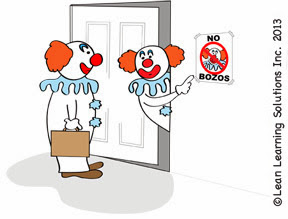
(One wonders, "Why are there so many bozos around here?")
Thirdly, strategy & problem solving begin with a mature acceptance of reality. Clichés just get in the way.
Holy cow, that's a rhinoceros and it just did something nasty on the carpet!
A clear concise description of the problem. Effective countermeasures will eventually follow.
Now consider how a cliché-ridden mind might respond:
"We need to think outside the box, lean in and ask clarifying questions! There is some low hanging fruit here, and perception is reality.
Let's consider our scalable options, get our ducks in a row and create synergy between our silos!"
Want to bet the rhino will still be there in an hour?
Here's one last reason:
Leadership is about language.
Best regards,
Pascal
In case you missed our last few blogs... please feel free to have another look…
Economy I and II - Never the Twain Shall Meet?
Strategy is Not About Doing What’s “Important”
Agriculture - The Next Frontier?
Lean Thinking in Software Design
Showing posts with label bozos. Show all posts
Monday, June 27, 2022
The Trouble with Corporate Clichés
Labels:
bozos,
Clichés,
Leadership
Monday, March 21, 2022
Bozos and HR
By Pascal Dennis (bio)
What a terrible waste of humanity – Taiichi Ohno
Our recent blog on Bozos generated some buzz - thanks, all. Thought I’d expand on a few points.
Poor HR policies and processes create bozos.
In the absence of purpose, and easy ways of getting involved, people lose their energy and optimism.
Over time their skills erode and they morph into bozos - a terrible waste, as Taiichi Ohno observed a long time ago.
You are what you have done. What you do now, is what you will be.
Meaningful, challenging work forces team members to stretch and grow. The best coaches know when to push, do they not?
That’s how we build character, and what the ancients called fortitude.
Core HR processes like recruitment, training & development, reward & recognition enable – or disable – growth.
At our old Toyota plant, HR processes were as clearly defined and purposeful as manufacturing processes. We had team boards, binary metrics, and a daily huddle.
We worked hard to make the ‘intangible’, tangible. “Morale, motivation, capability, growth” had concrete meaning.
That’s how an HR team expresses ‘respect for humanity’ – (an otherwise gassy phrase, no?)
In summary, most bozos are not born, they’re made, and strong HR processes are the countermeasure.
Best,
Pascal
In case you missed our last few blogs... please feel free to have another look…
Strategy and the Worlds of Thought & Experience
PDCA in the Trades
Nick Saban on the Power of Process Thinking
Lean and the Martial Arts
What a terrible waste of humanity – Taiichi Ohno
Our recent blog on Bozos generated some buzz - thanks, all. Thought I’d expand on a few points.
Poor HR policies and processes create bozos.
In the absence of purpose, and easy ways of getting involved, people lose their energy and optimism.
Over time their skills erode and they morph into bozos - a terrible waste, as Taiichi Ohno observed a long time ago.
You are what you have done. What you do now, is what you will be.
Meaningful, challenging work forces team members to stretch and grow. The best coaches know when to push, do they not?
That’s how we build character, and what the ancients called fortitude.
Core HR processes like recruitment, training & development, reward & recognition enable – or disable – growth.
At our old Toyota plant, HR processes were as clearly defined and purposeful as manufacturing processes. We had team boards, binary metrics, and a daily huddle.
We worked hard to make the ‘intangible’, tangible. “Morale, motivation, capability, growth” had concrete meaning.
That’s how an HR team expresses ‘respect for humanity’ – (an otherwise gassy phrase, no?)
In summary, most bozos are not born, they’re made, and strong HR processes are the countermeasure.
Best,
Pascal
In case you missed our last few blogs... please feel free to have another look…
Strategy and the Worlds of Thought & Experience
PDCA in the Trades
Nick Saban on the Power of Process Thinking
Lean and the Martial Arts
Labels:
bozos,
HR,
Taiichi Ohno,
Toyota
Monday, June 14, 2021
What is a Team?
By Pascal Dennis (bio)
A team is ‘an organized group of people with a clearly defined goal.’
"Organized" means team members have clearly defined & interconnected roles -- which in turn, depends on shared purpose.
In the absence of latter, our discourse inevitably devolves into random opinions, factoids and, often, recrimination.
"If only those bozos in... would do their jobs!"
Shared purpose shifts our thinking to, "Just how are we going to achieve that objective?"
What sort of objectives are most compelling & effective?
Objectives that are just beyond the capability of the team. (I've found that it's better to err on the side of too aggressive objectives, than the other way)
These compel collaboration. "We hang together -- or separately." Teamwork, therefore, entails interdependency.
Lean factories are organized such that team members in adjacent work zones can help one another and communicate freely.
Work thus becomes a relay race -- if need be, the faster runner can help the slower runner in the baton transfer zone.
(It triggers problem solving too. "Why is the team member always behind? Is it our layout, ergonomics, part fit...?)
Lean offices should be laid out this way too. I've seen finance, insurance, order fulfillment teams achieve remarkable performance levels thereby.
I've described some of the more visible aspects of teamwork.
The invisible is as important. Teams are connected by values, in other words, by shared standards of behaviour.
John Wooden's "sets of three" are good examples:
Tough standards - for me at least! But when a group of people is aligned around values, life becomes more predictable & they can relax.
That's another element of teamwork -- security.
Best,
Pascal
In case you missed our last few blogs... please feel free to have another look…
Target, Actual, Please Explain
Why Do ‘Smart’ People Struggle with Strategy?
Social Media & the Lean Business System -- Risks & Opportunities
Images and A3 Thinking
A team is ‘an organized group of people with a clearly defined goal.’
"Organized" means team members have clearly defined & interconnected roles -- which in turn, depends on shared purpose.
In the absence of latter, our discourse inevitably devolves into random opinions, factoids and, often, recrimination.
"If only those bozos in... would do their jobs!"
Shared purpose shifts our thinking to, "Just how are we going to achieve that objective?"
What sort of objectives are most compelling & effective?
Objectives that are just beyond the capability of the team. (I've found that it's better to err on the side of too aggressive objectives, than the other way)
These compel collaboration. "We hang together -- or separately." Teamwork, therefore, entails interdependency.
Lean factories are organized such that team members in adjacent work zones can help one another and communicate freely.
Work thus becomes a relay race -- if need be, the faster runner can help the slower runner in the baton transfer zone.
(It triggers problem solving too. "Why is the team member always behind? Is it our layout, ergonomics, part fit...?)
Lean offices should be laid out this way too. I've seen finance, insurance, order fulfillment teams achieve remarkable performance levels thereby.
I've described some of the more visible aspects of teamwork.
The invisible is as important. Teams are connected by values, in other words, by shared standards of behaviour.
John Wooden's "sets of three" are good examples:
- Don't lie. Don't cheat. Don't steal.
- Don't whine. Don't complain. Don't make excuses.
Tough standards - for me at least! But when a group of people is aligned around values, life becomes more predictable & they can relax.
That's another element of teamwork -- security.
Best,
Pascal
In case you missed our last few blogs... please feel free to have another look…
Target, Actual, Please Explain
Why Do ‘Smart’ People Struggle with Strategy?
Social Media & the Lean Business System -- Risks & Opportunities
Images and A3 Thinking
Monday, December 31, 2018
The Trouble with Corporate Clichés
By Pascal Dennis (bio)
"Think outside the box"
"Ducks in a row"
"Low-hanging fruit"
"Let's take this off-line"
Why do these and other corporate clichés make us cringe so?
Well, they're often used by lazy people to express stale, tired thinking.
If we haven't thought about something deeply, why burden people with inanities?
If we can't express an idea in a fresh way, why should anybody listen?
Secondly, clichés are often used by clueless people who want to sound intelligent, which can be unsettling.
(One wonders, "Why are there so many bozos around here?")
Thirdly, strategy & problem solving begin with a mature acceptance of reality. Clichés just get in the way.
Holy cow, that's a rhinoceros and it just did something nasty on the carpet!
A clear concise description of the problem. Effective countermeasures will eventually follow.
Now consider how a cliché-ridden mind might respond:
"We need to think outside the box, lean in and ask clarifying questions! There is some low hanging fruit here, and perception is reality.
Let's consider our scalable options, get our ducks in a row and create synergy between our silos!"
Want to bet the rhino will still be there in an hour?
Here's one last reason:
Leadership is about language.
Best regards,
Pascal
"Think outside the box"
"Ducks in a row"
"Low-hanging fruit"
"Let's take this off-line"
Why do these and other corporate clichés make us cringe so?
Well, they're often used by lazy people to express stale, tired thinking.
If we haven't thought about something deeply, why burden people with inanities?
If we can't express an idea in a fresh way, why should anybody listen?
Secondly, clichés are often used by clueless people who want to sound intelligent, which can be unsettling.
(One wonders, "Why are there so many bozos around here?")
Thirdly, strategy & problem solving begin with a mature acceptance of reality. Clichés just get in the way.
Holy cow, that's a rhinoceros and it just did something nasty on the carpet!
A clear concise description of the problem. Effective countermeasures will eventually follow.
Now consider how a cliché-ridden mind might respond:
"We need to think outside the box, lean in and ask clarifying questions! There is some low hanging fruit here, and perception is reality.
Let's consider our scalable options, get our ducks in a row and create synergy between our silos!"
Want to bet the rhino will still be there in an hour?
Here's one last reason:
Leadership is about language.
Best regards,
Pascal
Labels:
bozos,
Corporate Clichés,
Leadership
Monday, February 2, 2015
Reprise - What is a Team?
By Pascal Dennis
A team is ‘an organized group of people with a clearly defined goal.’
"Organized" means team members have clearly defined & interconnected roles -- which in turn, depends on shared purpose.
In the absence of latter, our discourse inevitably devolves into random opinions, factoids and, often, recrimination.
"If only those bozos in... would do their jobs!"
Shared purpose shifts our thinking to, "Just how are we going to achieve that objective?"
What sort of objectives are most compelling & effective?
Objectives that are just beyond the capability of the team. (I've found that it's better to err on the side of too aggressive objectives, than the other way)
These compel collaboration. "We hang together -- or separately." Teamwork, therefore, entails interdependency.
Lean factories are organized such that team members in adjacent work zones can help one another and communicate freely.
Work thus becomes a relay race -- if need be, the faster runner can help the slower runner in the baton transfer zone.
(It triggers problem solving too. "Why is the team member always behind? Is it our layout, ergonomics, part fit...?)
Lean offices should be laid out this way too. I've seen finance, insurance, order fulfillment teams achieve remarkable performance levels thereby.
I've described some of the more visible aspects of teamwork.
The invisible is as important. Teams are connected by values, in other words, by shared standards of behaviour.
John Wooden's "sets of three" are good examples:
Tough standards - for me at least! But when a group of people is aligned around values, life becomes more predictable & they can relax.
That's another element of teamwork -- security.
Best,
Pascal
A team is ‘an organized group of people with a clearly defined goal.’
"Organized" means team members have clearly defined & interconnected roles -- which in turn, depends on shared purpose.
In the absence of latter, our discourse inevitably devolves into random opinions, factoids and, often, recrimination.
"If only those bozos in... would do their jobs!"
Shared purpose shifts our thinking to, "Just how are we going to achieve that objective?"
What sort of objectives are most compelling & effective?
Objectives that are just beyond the capability of the team. (I've found that it's better to err on the side of too aggressive objectives, than the other way)
These compel collaboration. "We hang together -- or separately." Teamwork, therefore, entails interdependency.
Lean factories are organized such that team members in adjacent work zones can help one another and communicate freely.
Work thus becomes a relay race -- if need be, the faster runner can help the slower runner in the baton transfer zone.
(It triggers problem solving too. "Why is the team member always behind? Is it our layout, ergonomics, part fit...?)
Lean offices should be laid out this way too. I've seen finance, insurance, order fulfillment teams achieve remarkable performance levels thereby.
I've described some of the more visible aspects of teamwork.
The invisible is as important. Teams are connected by values, in other words, by shared standards of behaviour.
John Wooden's "sets of three" are good examples:
- Don't lie. Don't cheat. Don't steal.
- Don't whine. Don't complain. Don't make excuses.
Tough standards - for me at least! But when a group of people is aligned around values, life becomes more predictable & they can relax.
That's another element of teamwork -- security.
Best,
Pascal
Monday, September 8, 2014
Bozos and HR
By Pascal Dennis
What a terrible waste of humanity – Taiichi Ohno
Our recent blog on Bozos generated some buzz - thanks, all. Thought I’d expand on a few points.
Poor HR policies and processes create bozos.
In the absence of purpose, and easy ways of getting involved, people lose their energy and optimism.
Over time their skills erode and they morph into bozos - a terrible waste, as Taiichi Ohno observed a long time ago.
You are what you have done. What you do now, is what you will be.
Meaningful, challenging work forces team members to stretch and grow. The best coaches know when to push, do they not?
That’s how we build character, and what the ancients called fortitude.
Core HR processes like recruitment, training & development, reward & recognition enable – or disable – growth.
At our old Toyota plant, HR processes were as clearly defined and purposeful as manufacturing processes. We had team boards, binary metrics, and a daily huddle.
We worked hard to make the ‘intangible’, tangible. “Morale, motivation, capability, growth” had concrete meaning.
That’s how an HR team expresses ‘respect for humanity’ – (an otherwise gassy phrase, no?)
In summary, most bozos are not born, they’re made, and strong HR processes are the countermeasure.
Best,
Pascal
What a terrible waste of humanity – Taiichi Ohno
Our recent blog on Bozos generated some buzz - thanks, all. Thought I’d expand on a few points.
Poor HR policies and processes create bozos.
In the absence of purpose, and easy ways of getting involved, people lose their energy and optimism.
Over time their skills erode and they morph into bozos - a terrible waste, as Taiichi Ohno observed a long time ago.
You are what you have done. What you do now, is what you will be.
Meaningful, challenging work forces team members to stretch and grow. The best coaches know when to push, do they not?
That’s how we build character, and what the ancients called fortitude.
Core HR processes like recruitment, training & development, reward & recognition enable – or disable – growth.
At our old Toyota plant, HR processes were as clearly defined and purposeful as manufacturing processes. We had team boards, binary metrics, and a daily huddle.
We worked hard to make the ‘intangible’, tangible. “Morale, motivation, capability, growth” had concrete meaning.
That’s how an HR team expresses ‘respect for humanity’ – (an otherwise gassy phrase, no?)
In summary, most bozos are not born, they’re made, and strong HR processes are the countermeasure.
Best,
Pascal
Labels:
bozos,
HR,
Taiichi Ohno,
Toyota
Monday, September 1, 2014
The Question of Bozos
By Pascal Dennis
A tough one, which often confronts those of us in the transformation business.
I’ve found that transformation obstacles generally bubble up in the following sequence:
Technical – weak standards or adherence to standards for core activities
Organizational – team structure, org structure etc.
People – competence, motivation, mental models etc.
Systemic – governance obstacles, e.g. rewards & recognition structure, core beliefs & values, relationship between senior management & Board etc.
(Yes, they overlap somewhat)
The People category sometimes entails bozos (or as some people say, cement-heads).
Harsh terms perhaps, but a fact of life, and a potentially company-killing problem.
Here’s what I’ve learned. You have to cull the bozos.
Be fair, be humane. Provide fair and generous severance packages, help them find other jobs and so on, all in the spirit of decency.
But cull them. You’ll be stronger for it. In fact, team members will thank you and may ask, “What took you so long?”
Steve Jobs and Jim Collins have coined helpful mantras:
Jobs: ‘No bozos – ever.’
Collins: ‘Get the right people on the bus.’
(Check out Fireside Theatre’s classic comedy album, I Think We’re All Bozos on This Bus.)
An important reflection point for senior leaders:
How come there are so many bozos around here?
To paraphrase Shakespeare, “Some are born bozos, some achieve it, and others have it thrust upon them.”
Did we hire them? If so, what’s wrong with our recruitment processes?
Did we create them? If so, what’s wrong with our development and appraisal processes, and our culture?
The latter is especially tough. It means we may have let people down.
Why did we promote so many bozos? What’s wrong with our succession planning?
Tough questions -- which point to the centrality of Human Resources. (More to come on that one.)
Here’s a tough reflection point. We have a responsibility to hire good people, develop, involve and motivate them to be ‘the best they can be’.
If our organization is full of bozos, we’ve failed on every count.
Best,
Pascal
A tough one, which often confronts those of us in the transformation business.
I’ve found that transformation obstacles generally bubble up in the following sequence:
Technical – weak standards or adherence to standards for core activities
Organizational – team structure, org structure etc.
People – competence, motivation, mental models etc.
Systemic – governance obstacles, e.g. rewards & recognition structure, core beliefs & values, relationship between senior management & Board etc.
(Yes, they overlap somewhat)
The People category sometimes entails bozos (or as some people say, cement-heads).
Harsh terms perhaps, but a fact of life, and a potentially company-killing problem.
Here’s what I’ve learned. You have to cull the bozos.
Be fair, be humane. Provide fair and generous severance packages, help them find other jobs and so on, all in the spirit of decency.
But cull them. You’ll be stronger for it. In fact, team members will thank you and may ask, “What took you so long?”
Steve Jobs and Jim Collins have coined helpful mantras:
Jobs: ‘No bozos – ever.’
Collins: ‘Get the right people on the bus.’
(Check out Fireside Theatre’s classic comedy album, I Think We’re All Bozos on This Bus.)
An important reflection point for senior leaders:
How come there are so many bozos around here?
To paraphrase Shakespeare, “Some are born bozos, some achieve it, and others have it thrust upon them.”
Did we hire them? If so, what’s wrong with our recruitment processes?
Did we create them? If so, what’s wrong with our development and appraisal processes, and our culture?
The latter is especially tough. It means we may have let people down.
Why did we promote so many bozos? What’s wrong with our succession planning?
Tough questions -- which point to the centrality of Human Resources. (More to come on that one.)
Here’s a tough reflection point. We have a responsibility to hire good people, develop, involve and motivate them to be ‘the best they can be’.
If our organization is full of bozos, we’ve failed on every count.
Best,
Pascal
Labels:
bozos,
Fireside Theatre,
Jim Collins,
Steve Jobs
Thursday, May 22, 2014
The Trouble with Corporate Clichés
By Pascal Dennis
"Think outside the box"
"Ducks in a row"
"Low-hanging fruit"
"Let's take this off-line"
Why do these and other corporate clichés make us cringe so?
Well, they're often used by lazy people to express stale, tired thinking.
If we haven't thought about something deeply, why burden people with inanities?
If we can't express an idea in a fresh way, why should anybody listen?
Secondly, clichés are often used by clueless people who want to sound intelligent, which can be unsettling.
(One wonders, "Why are there so many bozos around here?")
Thirdly, strategy & problem solving begin with a mature acceptance of reality. Clichés just get in the way.
Holy cow, that's a rhinoceros and it just did something nasty on the carpet!
A clear concise description of the problem. Effective countermeasures will eventually follow.
Now consider how a cliché-ridden mind might respond:
"We need to think outside the box, lean in and ask clarifying questions! There is some low hanging fruit here, and perception is reality.
Let's consider our scalable options, get our ducks in a row and create synergy between our silos!"
Want to bet the rhino will still be there in an hour?
Here's one last reason:
Leadership is about language.
Best regards,
Pascal
"Think outside the box"
"Ducks in a row"
"Low-hanging fruit"
"Let's take this off-line"
Why do these and other corporate clichés make us cringe so?
Well, they're often used by lazy people to express stale, tired thinking.
If we haven't thought about something deeply, why burden people with inanities?
If we can't express an idea in a fresh way, why should anybody listen?
Secondly, clichés are often used by clueless people who want to sound intelligent, which can be unsettling.
(One wonders, "Why are there so many bozos around here?")
Thirdly, strategy & problem solving begin with a mature acceptance of reality. Clichés just get in the way.
Holy cow, that's a rhinoceros and it just did something nasty on the carpet!
A clear concise description of the problem. Effective countermeasures will eventually follow.
Now consider how a cliché-ridden mind might respond:
"We need to think outside the box, lean in and ask clarifying questions! There is some low hanging fruit here, and perception is reality.
Let's consider our scalable options, get our ducks in a row and create synergy between our silos!"
Want to bet the rhino will still be there in an hour?
Here's one last reason:
Leadership is about language.
Best regards,
Pascal
Labels:
bozos,
Corporate Clichés,
Leadership
Monday, November 28, 2011
"No Bozos -- Ever"
By Pascal Dennis
"No Bozos - Ever" Steve Jobs mantra!
An interesting expression of the Jim Collins principle, "Get the right people on this bus."
Hard to argue with the wisdom. Excellence entails prolonged focus by exceptional people on a noble goal.
Bozos distract teams from what's most important & ultimately degrade performance.
So, no bozos indeed.
But there are pitfalls.
What is a bozo? Do we have objective, fair criteria?
Or is our process a popularity contest?
Are we humane? Does everybody get a fair shot at proving themselves?
Do we have clear, simple standards for processes, hiring, performance, and strategy deployment?
If the answer to some of these questions is NO, then all bets are off.
I've found that people labeled as troublemakers (or "bozos") are simply bored or frustrated by the chaos all around them.
Give good people clear objectives, quick feedback, and the ability to improve their processes - and they flourish!
By contrast, "stars" that have risen in chaotic cultures often fall apart, when we clear the fog with standards, visual management and good processes.
I call this "splitting" and it's common in transformations.
So, let's heed the wisdom of Steve Jobs and Jim Collins with the caveats noted above.
Be fair and objective. Provide clear standards, quick feedback and clear direction.
Kaizen your recruitment process. Be clear on what you want in new team members & creative in how to check for those qualities.
Above all, be humane.
Everybody deserves a fair chance.
If you've hired people that don't fit - help them find a place where they do.
Cheers,
Pascal
"No Bozos - Ever" Steve Jobs mantra!
An interesting expression of the Jim Collins principle, "Get the right people on this bus."
Hard to argue with the wisdom. Excellence entails prolonged focus by exceptional people on a noble goal.
Bozos distract teams from what's most important & ultimately degrade performance.
So, no bozos indeed.
But there are pitfalls.
What is a bozo? Do we have objective, fair criteria?
Or is our process a popularity contest?
Are we humane? Does everybody get a fair shot at proving themselves?
Do we have clear, simple standards for processes, hiring, performance, and strategy deployment?
If the answer to some of these questions is NO, then all bets are off.
I've found that people labeled as troublemakers (or "bozos") are simply bored or frustrated by the chaos all around them.
Give good people clear objectives, quick feedback, and the ability to improve their processes - and they flourish!
By contrast, "stars" that have risen in chaotic cultures often fall apart, when we clear the fog with standards, visual management and good processes.
I call this "splitting" and it's common in transformations.
So, let's heed the wisdom of Steve Jobs and Jim Collins with the caveats noted above.
Be fair and objective. Provide clear standards, quick feedback and clear direction.
Kaizen your recruitment process. Be clear on what you want in new team members & creative in how to check for those qualities.
Above all, be humane.
Everybody deserves a fair chance.
If you've hired people that don't fit - help them find a place where they do.
Cheers,
Pascal
Labels:
bozos,
Jim Collins,
Kaizen,
Steve Jobs
Subscribe to:
Posts (Atom)