Showing posts with label Taiichi Ohno. Show all posts

Monday, March 24, 2025

Has OpEx/Lean Gone Wrong?

Pascal Dennis, author of Getting the Right Things Done

This question comes up repeatedly, so I thought I’d try to address it in a fresh way. My OpEx/Lean adventure began in the early 1990’s. I was a young engineer and manager fully absorbed with the Toyota Production System (TPS). My colleagues and I believed strongly that if we could master this way of thinking & working, we’d have a superpower: we could create Value in any industry and role we found ourselves in. Peter Drucker, Taiichi Ohno, Shigeo Shingo, and our formidable Toyota senseis were our guides.

Fast forward to today, and OpEx/Lean has truly lived up to its promise. Companies like Toyota, Honeywell, Danaher, and P&G continue to set the bar for excellence, and the Toyota Production System remains the gold standard for industries like energy, healthcare, and manufacturing If you dedicate your career to mastering these methods, you’re in good shape.

However, there’s a catch. Has OpEx/Lean kept up with the world of innovation? Have we incorporated insights from innovation giants like Clayton Christensen, Steve Blank, and Alex Osterwalder? And most importantly, do we understand the different mindsets and skillsets needed to continually Innovate at high level? I’ve written about Aristotle’s two worlds: Necessity (OpEx/Lean) and Contingency (Innovation). The key challenge is to understand them both at a deep level and figuring out how to switch between them seamlessly.

About a decade ago, I became absorbed by Innovation hot spots like Silicon Valley and Singapore. I began to study the achievements of Steve Jobs and Bill Gates, and the teaching of Clayton Christenson, Steve Blank, and Alex Osterwalder. I found an innovation sensei, my friend & co-author, Laurent Simon. Laurent & I developed a practice and wrote a book about our Innovation adventures in east Asia (here’s the book). My Innovation journey has been as rich & challenging as my TPS journey.

Pascal & Laurent – Innovation Sprint in Thailand during the Kratong Festival
© 2025 Lean Pathways Inc.

My eureka moment when Laurent and I started working together on innovation projects in the Asian plant-based drink industry. Our goal was to develop & launch a new product from scratch. Our inspiration and model was a French product that should have been a commodity but instead commanded a premium price (20%+) - even in countries that did not like the French!

We too, wanted to find our ‘blue ocean’ – engaged customers who loved our offering & were happy to pay a premium for the value they received. And we wanted to launch in half the time, and at half the cost. The innovation team succeeded; we met our targets, learned a ton, and had great fun. Moreover, the methods & mindset we applied have become the New Product Launch process standard.

Post-launch, the COO, a friend & supporter, said, “Every year, we work like crazy to reduce waste, and thereby boost profit by a few percent. You’ve just shown us how to boost profit by twenty percent…”

And this is perhaps why senior leaders see OpEx/Lean as necessary, but not sufficient. OpEx/Lean lays a solid foundation and reliably delivers waste reduction year upon year. But that’s not enough. We also need to ignite new Growth using the methods & mindsets of Silicon Valley and Singapore. We want to find our blue ocean, and the dedicated, engaged customers who happily pay a premium in return for offerings that delight them. Experimenting your way up the ‘hockey stick’ curve in pursuit of an elusive blue ocean is as exhilarating as launching a major new car model. The challenge for 21st C leaders is being able to lead both.

In summary, OpEx/Lean has not gone wrong, but OpEx/Lean leaders must embrace the methods & mindsets of Innovation. We must look outside the relatively predictable world of Operations, and into the volatile, uncertain, complex and ambiguous world of the customer.

Best wishes,

Pascal Dennis

E: pascal.dennis@leansystems.org

PS To learn more about my Strategy Execution program, Getting the Right Things Done in a Digital World, feel free to drop me a line.


In case you missed our last few blogs... please feel free to have another look…

If It’s Not Simple, It's…
Igniting New Growth – Aristotle’s Two Worlds, Part 2
Igniting New Growth – Aristotle’s Two Worlds
Innovation Does Not Begin with Technology


Monday, August 7, 2023

The Seven QC Tools, Part 4

By Pascal Dennis

(Experience & Reflection)

In earlier blogs I extolled the power of the "Q7"

Indeed, they're an indispensable part of our problem-solving arsenal.

Caveat: the Q7 are an abstraction that exist in the world of Reflection.

Good problem solving entails moving fluidly between the worlds of Reflection & Experience.

Go See (genchi genbutsu) is central to the latter.

Problem solving begins in the world of Experience.

What is actually happening right now? Go See the defect the moment you hear about it.

Or stand in a circle, as Taiichi Ohno suggested, until you see it in real time.

We then move to the world of Reflection to define What Is Actually Happening & What Should Be Happening.

Problem solving, of course, concludes in the world of Experience - otherwise it's just 'academic'.

This pattern -- experience - reflection - experience is central to practical problem solving and to Lean as a whole.

Lean thinkers are comfortable in both worlds.

My mental image: a person with one hand deeply embedded in the ground, and the other reaching for the sky.

Reflect, by all means, then get your butt to rough & tumble of the factory floor (or farm, lab, design studio, surgery...)

Best,

Pascal


In case you missed our last few blogs... please feel free to have another look…

Protecting The Core Business Is Not Enough
The Seven QC Tools, Part 3
The Seven QC Tools, Part 2
Pascal Dennis and the Enterprise Excellence podcast


Monday, April 18, 2022

Problem Solving and the Worlds of Reflection & Experience

By Pascal Dennis (bio)

Good problem solving entails moving fluidly between the worlds of Reflection & Experience.

Go See (genchi genbutsu) is central to the latter. Analytical tools like the famous Q7 Quality Tools are abstractions that exist in the world of Reflection.

Problem solving begins in the world of Experience.

What is actually happening right now? Go See the defect the moment you hear about it.

Or stand in a circle, as Taiichi Ohno suggested, until you see it in real time.


We then move to the world of Reflection to define What Is Actually Happening & What Should Be Happening.

Problem solving, of course, concludes in the world of Experience - otherwise it's just 'academic'.

This pattern -- experience - reflection - experience is central to practical problem solving and to Lean as a whole.

Lean thinkers are comfortable in both worlds.

My mental image: a person with one hand deeply embedded in the ground, and the other reaching for the sky.

Reflect, then get your butt to the gemba.

Reflection without action is lifeless. Action without reflection is aimless.

Best,

Pascal


In case you missed our last few blogs... please feel free to have another look…

Learning How to Manage
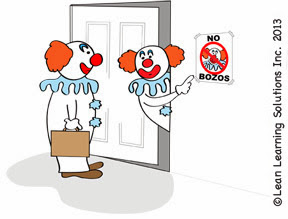
Bozos and HR
Strategy and the Worlds of Thought & Experience
PDCA in the Trades


Monday, March 21, 2022

Bozos and HR

By Pascal Dennis (bio)

What a terrible waste of humanity – Taiichi Ohno

Our recent blog on Bozos generated some buzz - thanks, all. Thought I’d expand on a few points.

Poor HR policies and processes create bozos.

In the absence of purpose, and easy ways of getting involved, people lose their energy and optimism.

Over time their skills erode and they morph into bozos - a terrible waste, as Taiichi Ohno observed a long time ago.

You are what you have done. What you do now, is what you will be.

Meaningful, challenging work forces team members to stretch and grow. The best coaches know when to push, do they not?

That’s how we build character, and what the ancients called fortitude.

Core HR processes like recruitment, training & development, reward & recognition enable – or disable – growth.

At our old Toyota plant, HR processes were as clearly defined and purposeful as manufacturing processes. We had team boards, binary metrics, and a daily huddle.

We worked hard to make the ‘intangible’, tangible. “Morale, motivation, capability, growth” had concrete meaning.

That’s how an HR team expresses ‘respect for humanity’ – (an otherwise gassy phrase, no?)

In summary, most bozos are not born, they’re made, and strong HR processes are the countermeasure.

Best,

Pascal


In case you missed our last few blogs... please feel free to have another look…

Strategy and the Worlds of Thought & Experience
PDCA in the Trades
Nick Saban on the Power of Process Thinking
Lean and the Martial Arts


Monday, March 7, 2022

Strategy and the Worlds of Thought & Experience

By Pascal Dennis (bio)

Strategy, like all problem solving, entails moving fluidly between the worlds of Thought & Experience.

We begin by trying to understand our core problem in the world of thought. We reflect on core strategic questions such as:

  • What happened last year, and why?
  • What worked, what did not work, and why?
  • What do our customers expect of us?
  • What do we need to achieve this year?
  • What are our biggest obstacles?
  • What’s changed in our environment?
  • How capable is our team & our processes?

We use analytical tools like the ‘Q7’ and ‘New 7’ Quality Tools to begin to dispel the fog. Based on our understanding of our customers, organization, industry, technology etc. we begin form hypotheses around the core questions. (A professor pal tells me this is called ‘deductive reasoning’.)

Now we’re ready to ‘go see’ the world of experience. We want to sample as much of this world as we can. In a large organization, we should visit as many sites as possible. Stand in a circle if you can, as Taiichi Ohno suggest, until you see what’s actually happening. Then go somewhere else and do the same. It’s akin to crossing a river by jumping stone to stone, lingering a while at each. The more we sample, the more likely we are to grasp the underlying situation. (My pal tells me this is ‘inductive reasoning’.)

We then return to the world of thought to define the strategic problem (What Is Actually Happening & What Should Be Happening), what’s preventing us, and what we might do about it.

This movement between thought & experience is central to strategy and problem solving in general.

We need to be comfortable in both worlds - one hand digging deep into the earth, the other reaching for the sky.

Thought without action is lifeless. Action without thought is aimless.

Best,

Pascal


In case you missed our last few blogs... please feel free to have another look…

PDCA in the Trades
Nick Saban on the Power of Process Thinking
Lean and the Martial Arts
Daily PDCA is a Meditation


Monday, November 2, 2020

Practical Problem Solving – Proving Cause & Effect

By Pascal Dennis (bio)

"Improvement is endless and eternal" – Taiichi Ohno

At Toyota I learned the following problem solving drill:
  1. Do I have a problem?
  2. Do I know the cause?
  3. Have I proven cause & effect?
  4. Have I confirmed the countermeasure?
Question 3 is a common failure point. Humans are wired to jump to countermeasures. Testing cause and effect, by contrast, takes time. You have to develop a hypothesis, then run experiments to prove, or disprove it.

Recently, our family had the interesting opportunity to apply the drill.
  1. Do we have a Problem?

  2. Yes - an annoying rattle coming from the dashboard of our RX 350 Lexus truck. (Very surprising for a vehicle built by the splendid Toyota team in Cambridge Ontario.)

  3. Do we know the cause?
After looking under the hood, driving at different speeds, on different kinds of ground, we were unable to locate the source.

Lexus technicians also checked, but detected no evidence of a rattle in the cabin. But soon after, there it was again!

My wife, always alert, then made an interesting observation. “Hmmm, the truck never rattles when you’re wearing your sun glasses.”

And sure enough, when the truck was with Lexus maintenance, I’d taken my sun glasses with me.

You can imagine our next steps. We ran a number of variations on the following experiments:
  • Sun glasses in storage position
  • Sun glasses on Pascal’s head

The result?
  • Sun glasses in storage position – rattle
  • Sun glasses on Pascal’s head – no rattle

Thereby, we were able to turn the problem on and off, the ultimate test of cause and effect.

Countermeasures, for our family at least, are clear. But what’s the countermeasure for Lexus, whose marketing extols the world’s ‘quietest cabin’?

An unanticipated failure mode! So it goes. That’s why we say, improvement is endless and eternal!

I have great faith in Lexus. Vibration absorption in the sun glasses storage area comes to mind.

(As for a rattling head, no comment.)

Best,

Pascal


In case you missed our last few blogs... please feel free to have another look…

Lean Means Don’t Be a Dumb-Ass
Lean – So ‘Easy’, It’s Hard
“Failing to Plan is Planning to Fail”
Building Quality into the Process


Monday, May 4, 2020

What is Breakthrough?, Part 2

By Pascal Dennis (bio)

Breakthrough comes in different flavors.

Those of us who've grown up in manufacturing tend to think in terms of Operational Excellence - whose objective is Efficiency.

We seek to enhance flow in our major value streams by reducing waste (muda).

Our breakthrough activities typically focus on Manpower, Machinery, Methods and Materials.

Taiichi Ohno, our Godfather & founder of the Toyota Production System (TPS), famously declared:

"All we are trying to do is reduce the time between the customer ordering the product and our getting paid."

The system Ohno developed is justly famous, revered & imitated.

But is that all there is to Breakthrough?

Efficiency is a splendid capability, and often sufficient in itself. But is that all there is?

Don't wish to be misunderstood. TPS, in my view, is one of the past half century's grandest achievements.

But in his travels, your business nomad has learned that there's always another mountain range.

Apple, for example, has repeatedly shown that Effectiveness - doing the right things - can trump Efficiency.

The IPhone, IPod and IPad are not terribly well made. (How many drops before your IPad stops working?)

Do the corresponding value streams flow?

But the Design is so elegant, it doesn't matter.

In this case, getting the right things done, trumps doing things right.

In summary, the topography of business is complex & dynamic. There's always another mountain range.

Lean thinkers need to reflect on what we don't know, which far exceeds what we do know.

In upcoming blogs I'll dig into other kinds of breakthrough.

Best,

Pascal


In case you missed our last few blogs... please feel free to have another look…

What Does Breakthrough Mean? - Part 1
Suggestion boxes vs Quick & Easy Kaizen
What is Intellectual Capital?, Part 2
What is Intellectual Capital & Why Should You Care?


Monday, November 4, 2019

KAIZEN – Small Changes vs. Monster Projects

By Al Norval (bio)

As an engineer in school I studied the physical sciences - Chemistry, Physics, Differential Calculus and my favorite Statistics but lately I’ve been studying things which I would have laughed at when I was in Engineering school. That is the behavioral sciences of Adult Learning and Change Management. Specifically I’m interested in why people are afraid of change, how to overcome it and how to maximize the learning we get from making changes.


Turns out it goes way back to the dawn of humanity as our brains were developing. Simply put, our brains have three sections; the reptilian or limbic brain located at the brain stem which controls our basic functions; our mammalian brain which contains our emotional center, and the prefrontal cortex which is the part of the brain that is most developed in primates and makes us most human in that it contains the reasoning and logic centers.

Our limbic system is much older than the other structures in our brains and developed to manage the “Flight or Fight” response. That’s the part of our brain that responds to threatening situations with a response that decides either to run away – the flight or to stand and fight. The decision isn’t based on logic or even emotion but is decided upon by this ancient part of our brain that overrides the other more highly advanced sections of the brain. It’s a basic survival mechanism.

What has this got to do with Kaizen?

This same mechanism kicks in when we are faced with changes. Its part of the fear of change and overcoming it is a large part of change management.

I’d like to suggest that kaizen can be a great way of overcoming this fear of change and can greatly simplify change management. By kaizen I mean kaizen as small, steady, relentless continuous improvement not as big workshops or events. The kind of Quick & Easy Kaizen that is practiced every day.

Turns out we can absorb small changes and that a series of small changes is easier to make than one big change. The key is the repetition. Small daily changes quickly turn into a routine that is no longer threatening. It becomes a habit and minimizes the threat and so minimizes the Flight or Fight response.

Small changes add up to big improvements over time. That’s not to say there isn’t the need for the occasional kaizen workshop but temper them with daily kaizen perhaps at a ratio of 10:1 or even 100:1

The words of Taiichi Ohno ring in my ears “Every day a little bit higher”.

What does this mean for the Lean community? Don’t fight basic biology. Combine daily Quick & Easy Kaizen with a focus on delivering Customer value you can use it to your advantage. You’ll get more improvement done quicker with less resistance. Go ahead and try it. I’d love to hear how you did.

Cheers,

Al


In case you missed our last few blogs... please feel free to have another look…

Is Inventory a waste or a cover-up of deeper waste?
7 Basic Quality Tools – Are they underrated?
What Does Leader as a Teacher Really Mean?
PDCA - the Pounding Heart Muscle of Life


Monday, February 5, 2018

Strategy and the Worlds of Thought & Experience

By Pascal Dennis (bio)

Strategy, like all problem solving, entails moving fluidly between the worlds of Thought & Experience.

We begin by trying to understand our core problem in the world of thought. We reflect on core strategic questions such as:

  • What happened last year, and why?
  • What worked, what did not work, and why?
  • What do our customers expect of us?
  • What do we need to achieve this year?
  • What are our biggest obstacles?
  • What’s changed in our environment?
  • How capable is our team & our processes?

We use analytical tools like the ‘Q7’ and ‘New 7’ Quality Tools to begin to dispel the fog. Based on our understanding of our customers, organization, industry, technology etc. we begin form hypotheses around the core questions. (A professor pal tells me this is called ‘deductive reasoning’.)

Now we’re ready to ‘go see’ the world of experience. We want to sample as much of this world as we can. In a large organization, we should visit as many sites as possible. Stand in a circle if you can, as Taiichi Ohno suggest, until you see what’s actually happening. Then go somewhere else and do the same. It’s akin to crossing a river by jumping stone to stone, lingering a while at each. The more we sample, the more likely we are to grasp the underlying situation. (My pal tells me this is ‘inductive reasoning’.)

We then return to the world of thought to define the strategic problem (What Is Actually Happening & What Should Be Happening), what’s preventing us, and what we might do about it.

This movement between thought & experience is central to strategy and problem solving in general.

We need to be comfortable in both worlds - one hand digging deep into the earth, the other reaching for the sky.

Thought without action is lifeless. Action without thought is aimless.

Best,

Pascal


Monday, December 12, 2016

Problem Solving and the Worlds of Reflection & Experience

By Pascal Dennis

Good problem solving entails moving fluidly between the worlds of Reflection & Experience.

Go See (genchi genbutsu) is central to the latter. Analytical tools like the famous Q7 Quality Tools are abstractions that exist in the world of Reflection.

Problem solving begins in the world of Experience.

What is actually happening right now? Go See the defect the moment you hear about it.

Or stand in a circle, as Taiichi Ohno suggested, until you see it in real time.


We then move to the world of Reflection to define What Is Actually Happening & What Should Be Happening.

Problem solving, of course, concludes in the world of Experience - otherwise it's just 'academic'.

This pattern -- experience - reflection - experience is central to practical problem solving and to Lean as a whole.

Lean thinkers are comfortable in both worlds.

My mental image: a person with one hand deeply embedded in the ground, and the other reaching for the sky.

Reflect, then get your butt to the gemba.

Reflection without action is lifeless. Action without reflection is aimless.

Best,

Pascal


Monday, July 25, 2016

The Seven QC Tools, Part 4

By Pascal Dennis

(Experience & Reflection)

In earlier blogs I extolled the power of the "Q7"

Indeed, they're an indispensable part of our problem-solving arsenal.

Caveat: the Q7 are an abstraction that exist in the world of Reflection.

Good problem solving entails moving fluidly between the worlds of Reflection & Experience.

Go See (genchi genbutsu) is central to the latter.

Problem solving begins in the world of Experience.

What is actually happening right now? Go See the defect the moment you hear about it.

Or stand in a circle, as Taiichi Ohno suggested, until you see it in real time.

We then move to the world of Reflection to define What Is Actually Happening & What Should Be Happening.

Problem solving, of course, concludes in the world of Experience - otherwise it's just 'academic'.

This pattern -- experience - reflection - experience is central to practical problem solving and to Lean as a whole.

Lean thinkers are comfortable in both worlds.

My mental image: a person with one hand deeply embedded in the ground, and the other reaching for the sky.

Reflect, by all means, then get your butt to rough & tumble of the factory floor (or farm, lab, design studio, surgery...)

Best,

Pascal


Monday, February 15, 2016

Lean Thinking in Software Design

By Pascal Dennis

One of my great work pleasures is helping to translate the System of Profound Knowledge, as Deming called it, for new and different industries.

Taiichi Ohno, Deming, Shingo, Juran et al have given us fundamental principles gained through hard experience.

But we have to translate these so they work for us in the here and now.

Thus, Lean is both

  • Do – a set of principles that informs one’s life, and a

  • Jutsu – a practical set of techniques that works

It’s fun translating visual management, standardized work, quality in the process and other fundamentals in industries like software design.

Agile, Scrum and related practices are very simpatico with Lean. In fact, if I may suggest, they are Lean’s child (or grandchild).

Our software partners recognize the need for an integrated management system that aligns things like:

  • Purpose

  • Core Mental Models – how we think

  • Two work streams: Run the Business, and Improve the Business

  • Connected Level 1, 2 and 3 checking

  • Leader Standard Work & Daily Accountability

  • People & Leadership Develop

  • The Four Rules etc.

If we check well, reality gives us frank, binary feedback: OK or Not OK.

The answer is usually the latter! And, as ever, we learn by doing. Each organization’s journey is unique and their own. Coaches are guides, whisperers, and on occasion, taskmasters.

Step by step we walk the narrow path to enlightenment and good business results! We must have both, no?

We partially succeed – and that makes all the difference.

Best regards,

Pascal


Monday, September 15, 2014

Practical Problem Solving – Proving Cause & Effect

By Pascal Dennis

"Improvement is endless and eternal" – Taiichi Ohno

At Toyota I learned the following problem solving drill:
  1. Do I have a problem?
  2. Do I know the cause?
  3. Have I proven cause & effect?
  4. Have I confirmed the countermeasure?
Question 3 is a common failure point. Humans are wired to jump to countermeasures. Testing cause and effect, by contrast, takes time. You have to develop a hypothesis, then run experiments to prove, or disprove it.

Recently, our family had the interesting opportunity to apply the drill.
  1. Do we have a Problem?

  2. Yes - an annoying rattle coming from the dashboard of our RX 350 Lexus truck. (Very surprising for a vehicle built by the splendid Toyota team in Cambridge Ontario.)

  3. Do we know the cause?
After looking under the hood, driving at different speeds, on different kinds of ground, we were unable to locate the source.

(My teenage daughter Katie drolly suggested the rattling was coming from my head, but let’s put that aside.)

Lexus technicians also checked, but detected no evidence of a rattle in the cabin. But soon after, there it was again!

My wife, always alert, then made an interesting observation. “Hmmm, the truck never rattles when you’re wearing your sun glasses.”

And sure enough, when the truck was with Lexus maintenance, I’d taken my sun glasses with me.

You can imagine our next steps. We ran a number of variations on the following experiments:
  • Sun glasses in storage position
  • Sun glasses on Pascal’s head

The result?
  • Sun glasses in storage position – rattle
  • Sun glasses on Pascal’s head – no rattle

Thereby, we were able to turn the problem on and off, the ultimate test of cause and effect.

Countermeasures, for our family at least, are clear. But what’s the countermeasure for Lexus, whose marketing extols the world’s ‘quietest cabin’?

An unanticipated failure mode! So it goes. That’s why we say, improvement is endless and eternal!

I have great faith in Lexus. Vibration absorption in the sun glasses storage area comes to mind.

(As for a rattling head, no comment.)

Best,

Pascal


Monday, September 8, 2014

Bozos and HR

By Pascal Dennis

What a terrible waste of humanity – Taiichi Ohno

Our recent blog on Bozos generated some buzz - thanks, all. Thought I’d expand on a few points.

Poor HR policies and processes create bozos.

In the absence of purpose, and easy ways of getting involved, people lose their energy and optimism.

Over time their skills erode and they morph into bozos - a terrible waste, as Taiichi Ohno observed a long time ago.

You are what you have done. What you do now, is what you will be.

Meaningful, challenging work forces team members to stretch and grow. The best coaches know when to push, do they not?

That’s how we build character, and what the ancients called fortitude.

Core HR processes like recruitment, training & development, reward & recognition enable – or disable – growth.

At our old Toyota plant, HR processes were as clearly defined and purposeful as manufacturing processes. We had team boards, binary metrics, and a daily huddle.

We worked hard to make the ‘intangible’, tangible. “Morale, motivation, capability, growth” had concrete meaning.

That’s how an HR team expresses ‘respect for humanity’ – (an otherwise gassy phrase, no?)

In summary, most bozos are not born, they’re made, and strong HR processes are the countermeasure.

Best,

Pascal


Monday, December 2, 2013

Standardized Work and Innovation

By Al Norval

Like many of you in the Lean community, I work very hard to get organizations to implement Standardized Work and follow standard processes. The result is huge improvement through a reduction in waste and variation. Value begins to flow and there is a deeper connection to the customer.

But Standardized Work can have a dark side as well. This was highlighted in the teaching of Frederick Taylor who introduced the idea of “Division of Labor” and breaking down work into smaller and smaller fragments. Each of the fragments were optimized by legions of staff using well intentioned time and motion studies. What were they missing in this approach? After all they were fundamentally just taking waste out of the work.

The key is the improvements were done to the people rather than having the people who do the work drive the improvement process. The result – a completely disengaged workforce with low morale and the vision of people robotically working machines alienated from any connection to the final customer.

So what’s different today?

We still want the benefits of Standardized Work but we recognize the need for people to be engaged. People don’t naturally work as islands unto themselves. Cross-functional teams or quality circles allow team members to interact with one another. This interaction allows innovation to flourish and teams to come up with creative solutions to problems . New ideas are generated which are often the result of a combination of ideas thrown out by people and built up as the team has dialogue and discussions. No one person has all the ideas and all the answers.

Taiichi Ohno had a saying that I’ll paraphrase as “There can be no improvement without standards” since without standards we couldn’t apply the scientific method and experiment and learn from our improvements.

To get real innovation we need both Standardized Work and cross-functional teams engaged in solving problems.

Result – stimulated employees who are constantly driving towards the goals of the organization.

Sounds a lot like “Respect for People” which arguably is the most important pillar of Lean.

Which is better – an organization that uses Standardized Work as a straightjacket stifling the creativity of people or one that uses Standardized Work as the basis for engagement and Innovation?

Cheers


Monday, November 11, 2013

Go See & the Seven QC Tools

by Pascal Dennis

(Experience & Reflection)

In earlier blogs I extolled the power of the "Q7"

Indeed, they're an indispensable part of our problem-solving arsenal.

Caveat: the Q7 are an abstraction that exist in the world of Reflection.


Good problem solving entails moving fluidly between the worlds of Reflection & Experience.

Go See (genchi genbutsu) is central to the latter.

Problem solving begins in the world of Experience.

What is actually happening right now? Go See the defect the moment you hear about it.

Or stand in a circle, as Taiichi Ohno suggested, until you see it in real time.

We then move to the world of Reflection to define What Is Actually Happening & What Should Be Happening.

Problem solving, of course, concludes in the world of Experience - otherwise it's just 'academic'.

This pattern -- experience - reflection - experience is central to practical problem solving and to Lean as a whole.

Lean thinkers are comfortable in both worlds.

My mental image: a person with one hand deeply embedded in the ground, and the other reaching for the sky.

Reflect, by all means, then get your butt to rough & tumble of the factory floor (or farm, lab, design studio, surgery...)

Best,

Pascal


Thursday, August 8, 2013

What is Breakthrough?, Part 2

By Pascal Dennis

Breakthrough comes in different flavors.

Those of us who've grown up in manufacturing tend to think in terms of Operational Excellence - whose objective is Efficiency.

We seek to enhance flow in our major value streams by reducing waste (muda).

Our breakthrough activities typically focus on Manpower, Machinery, Methods and Materials.

Taiichi Ohno, our Godfather & founder of the Toyota Production System (TPS), famously declared:

"All we are trying to do is reduce the time between the customer ordering the product and our getting paid."

The system Ohno developed is justly famous, revered & imitated.

But is that all there is to Breakthrough?

Efficiency is a splendid capability, and often sufficient in itself. But is that all there is?

Don't wish to be misunderstood. TPS, in my view, is one of the past half century's grandest achievements.

But in his travels, your business nomad has learned that there's always another mountain range.

Apple, for example, has repeatedly shown that Effectiveness - doing the right things - can trump Efficiency.

The IPhone, IPod and IPad are not terribly well made. (How many drops before your IPad stops working?)

Do the corresponding value streams flow?

But the Design is so elegant, it doesn't matter.

In this case, getting the right things done, trumps doing things right.

In summary, the topography of business is complex & dynamic. There's always another mountain range.

Lean thinkers need to reflect on what we don't know, which far exceeds what we do know.

In upcoming blogs I'll dig into other kinds of breakthrough.

Best,

Pascal


Monday, July 15, 2013

Doing the Right Things vs. Doing Things Right

By Pascal Dennis

Effectiveness versus Efficiency - an eternal challenge.

Those of us who've grown up in manufacturing naturally lean toward to latter.

We know how to do things right - how to reduce waste & thereby, Lead Time.

As Taiichi Ohno famously said, "All we're trying to do is reduce Lead Time."

It takes a lifetime to learn how to do this, (at least for me.)

Efficiency - (Execution, Operational Excellence, call it what you will) - often trumps everything.

But not always.

What if Efficiency is not the constraint?

Can you think of any examples of value streams that are inefficient, but still fabulously successful?

(Hint: IPod, IPhone, IPad...)

Are Apple's value streams the most efficient? Is the IPad, for example, as well built, as, say, a Toyota Corolla?

(If you have teenage daughters, as I do, you may already know the answer. Try dropping your IPad a few times!)

But Apple's design is so transcendent, it doesn't matter. When Steve Jobs unveiled the IPad, everybody wanted one.

Price and robustness were not an issue. In other words, here, Effectiveness trumps Efficiency.

Don't want to be misunderstood. I am not saying that Efficiency is of no consequence. Quite the contrary.

In fact, Samsung's combination of strong design plus robust manufacturing is challenging Apple.

The combination allows Samsung launch multiple products, cull the losers, and double down on the winners.

Please reflect on these ideas - in Strategy, above all.

(As I said, manufacturing mental models tend to lean in one direction.)

A common, subtle failure mode is focusing on Efficiency, when it's not the constraint.

Best regards,

Pascal

PS Reflections of a Business Nomad - the audiobook is in progress!

We're in the recording studio now. Keep you posted. Thanks for your encouragement.

Thursday, June 13, 2013

Building Intellectual Capital

By Pascal Dennis

What's the proper role of the Kaizen/Continuous Improvement Office?

I was taught that it was three-fold:
  1. To create capability
  2. To share learning
  3. To create kaizen spirit
More and more though, I think about the great Taiichi Ohno.

"I am not just building cars - I am building people!"

A splendid concept from a true revolutionary.

I am building people!

Underlying this sentiment was Ohno's remarkable respect for people - expressed by challenging them to do their very best!


Tough love indeed.

I've been privileged to have such senseis, both at Toyota and in Aikido.

But how does this help the corporation? Where does this show up on the Balance Sheet?

Sadly, it doesn't - for now.

But I am hopeful that before too long Intellectual Capital will begin to appear on Balance Sheets

Intellectual Capital means people - and their capability, creativity, flexibility, sense of urgency, knowledge, relationships and camaraderie.

At companies like Google, Apple, Amazon, Facebook, Intellectual Capital dwarfs financial and physical assets.

So how can we continue to ignore it?

So, let me suggest that in the next decade, the Kaizen/CI Office needs to think as follows:

Our job is to create Intellectual Capital - by growing people.

Best,

Pascal

Thursday, May 30, 2013

Is Our Thinking Up to the Challenge of the 21st Century?

By Pascal Dennis

In an earlier blog I asked the above question.

I'd compared our situation in 2013, with that of the designers, engineers and managers of the Titanic, a century earlier.

I suggested that we, too, we unprepared for our century's management challenges.

(Don't want to be misunderstood - I am NOT suggesting any imminent catastrophe.)

I've dedicated myself to deepening & extending our mental models.

I'd like to help teach the thinking way I was so fortunate to learn.

In my view, our deepest and most common management dysfunction is in our treatment of people.

We are very good at managing Financial and Physical Assets (Capital), and a good part of the curriculum of business and engineering school focuses here.

This is necessary, of course, but is it sufficient?

In a world dominated by Google, Apple, Facebook and Amazon, isn't Intellectual Capital even more important?

(Lean thinkers, please forgive the accounting jargon.)

Yet, we manage people, the source of our Intellectual Capital, in haphazard or even plainly foolish ways.

Jack Welch famously said that Human Resources are the most important department.

Jack took some heat for it, but, as usual, he was prescient.

The world's best organizations invest heavily in their people.

The explicit deal is:

  • We'll invest in you, make you more skilled and employable, and give you a job for as long as you want it.
  • You'll help us be successful

Taiichi Ohno's Respect for People concept, remarkable in the late 1940's, with WWII's scars still open, is an early expression.

In blogs to come I'll dig deeper into how we might manage Intellectual Capital better.

Again, please forgive the accounting jargon, but we need to learn to talk to the CFO.

Best,

Pascal